
Daily Bias
© A simple mechanical framework for building daily bias using previous day highs and lows, equilibrium, wick behavior, and lower-timeframe confirmation.
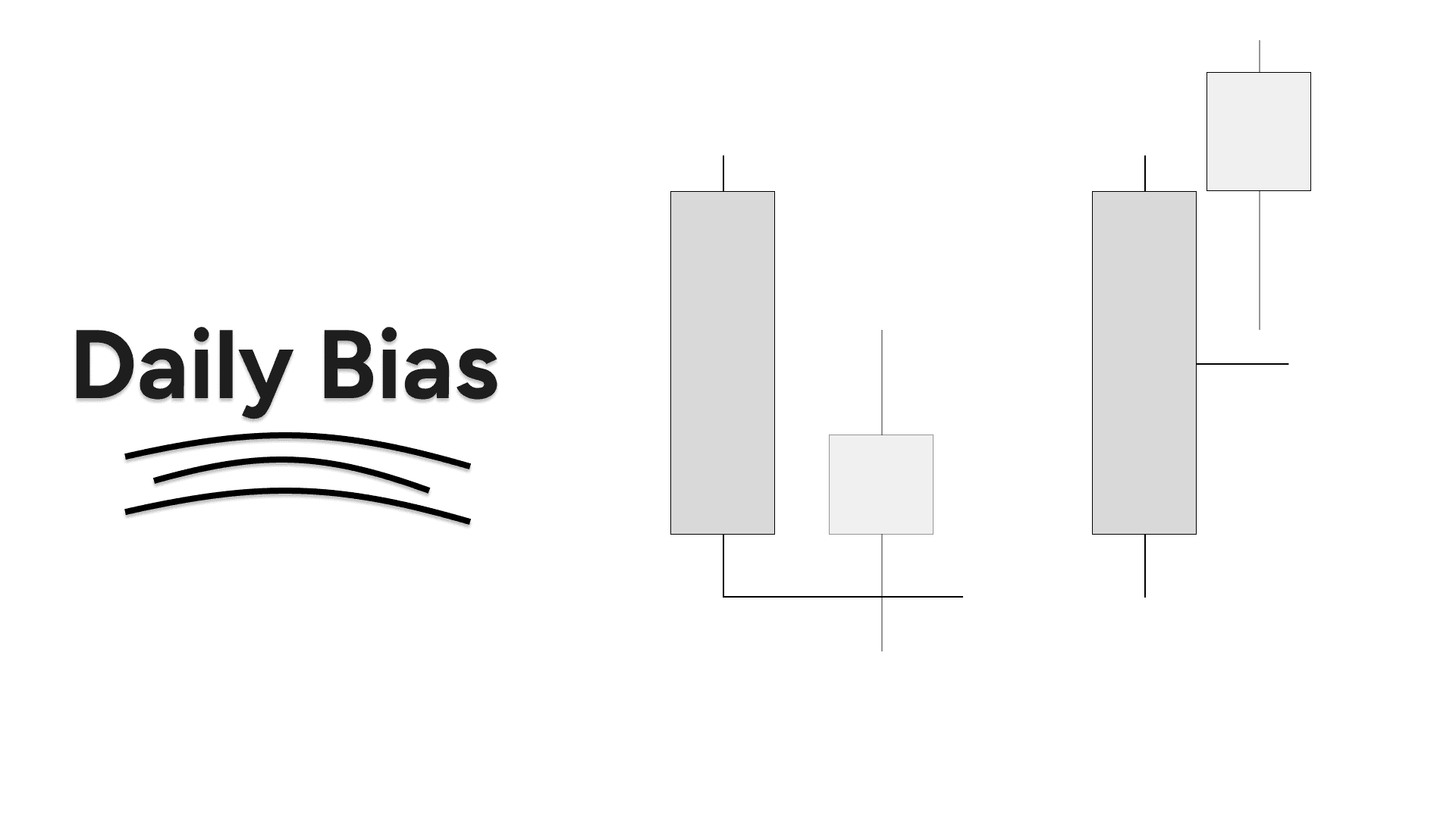
Start with one question: reversal or continuation?
Every trading day can be framed through a simple decision: is price setting up for a reversal, or preparing for continuation? In this framework, reversals are built around the previous day’s high or low, while continuations are framed around the equilibrium of the previous day’s range. The goal is not prediction. The goal is clarity. Once that structure is set, candle closures and wick behavior help determine whether there is immediate opportunity or whether confirmation is still needed.
This framework works best when paired with an understanding of equilibrium, candle closures, and change in the state of delivery. Those concepts create the context that keeps the model mechanical instead of emotional.
Reversal logic, wick behavior, and confirmation
A reversal day usually begins at a key reference point such as the previous day’s high or low. For example, after a bullish daily candle closes near the high, the next session may trade back into that high and form a bearish reversal. A shallow wick supports expansion away from the level, while a large wick suggests weaker intent and often calls for more patience. Instead of forcing the first touch, the framework waits for confirmation from a lower timeframe change in the state of delivery before entry.
Small wick supports expansion.
Large wick usually requires more confirmation.
Lower-timeframe CISD confirms the higher-timeframe setup.
Continuation days are framed through equilibrium
Continuation logic starts with the prior candle close and the equilibrium of the previous day’s range. After a bullish close, the expectation is that price may open, trade lower first, respect equilibrium, and then continue through the previous day’s high. The same logic can be inverted for bearish continuation days using the previous day’s low. The important part is not perfect touch precision, but whether price respects the area structurally and aligns with the broader bias.
The framework is also fractal. It is often applied with the daily and hourly, or the four-hour and 15-minute, but the same logic can be used on lower combinations as long as the higher timeframe still provides meaningful structure. Used correctly, the model gives a repeatable way to define direction before execution instead of reacting randomly in the session.